
Total: $0.00
Taxes and shipping calculated at checkout

If you have spent any amount of time cleaning up your diet, eliminating processed food, reading ingredient labels, or recovering from a health crisis, you already know: what you eat matters. It matters when life is normal. It matters even more when life is not.
And yet, the emergency food industry operates as though health-conscious people do not exist.
Open up the ingredient list on many conventional emergency food buckets and you may find MSG or hydrolyzed proteins, artificial flavors, hydrogenated oils, soy protein isolate, maltodextrin, and high levels of sodium. These products are often marketed heavily on shelf life, calorie counts, and total servings, even when those serving totals include items like oatmeal, rice, or drink mixes alongside entrees.
That is not preparedness. That is a pantry full of the same processed junk you stopped eating years ago, sealed in a bucket and priced at a premium because it has a 25-year shelf life.
This guide is for families who refuse to make that tradeoff. You should not have to choose between being prepared and eating clean. And with the right information, you do not have to.
The emergency food industry has a dirty secret, and it is hiding in plain sight on every ingredient label.
The filler problem. Some emergency food brands advertise large serving counts that include breakfasts, grains, sides, or drinks alongside entrees. A serving of oatmeal can be useful food, but it is not equivalent to a hearty lunch or dinner entree. When a company advertises a "360-serving bucket," look at what types of food those servings actually represent rather than relying on the headline number alone.
The ingredient problem. Emergency food is manufactured for shelf life and cost, not nutritional quality. Common ingredients worth watching for include: monosodium glutamate (MSG) and hydrolyzed proteins, soy protein isolate and soy lecithin, partially hydrogenated oils and palm oil, artificial colors and flavors, high levels of sodium, and maltodextrin.
The certification problem. Many brands use terms like "wholesome" and "natural" without meaningful third-party verification. Look instead for defined standards such as USDA Organic certification through an accredited certifier like CCOF, or independent programs such as Non-GMO Project Verified when applicable to the specific product.
If you would not feed these ingredients to your family on a Tuesday night, why would you feed them during a crisis when your body is already under stress?
The same standards you apply at the grocery store should apply to your emergency supply. Here is what actually matters:
Third-party certifications. USDA Organic means a product is produced according to federal organic standards, which prohibit GMOs and place strict limits on synthetic pesticides, fertilizers, and other inputs. CCOF is a USDA-accredited organic certifier. Non-GMO Project Verified is a separate third-party verification program for products that meet its standards. Look at which certifications apply to the specific product you are considering rather than relying on general brand claims.
Short, readable ingredient lists. You should be able to recognize what you are eating. If the list reads like a chemistry textbook, take a closer look before adding it to your long-term food supply.
Transparent serving counts. Look beyond the headline number and see what the servings actually include. How many are prepared entrees, breakfasts, grains, milk, seeds, sides, or other foods? Comparing the composition of the bucket gives you a much clearer picture of its real value than the advertised serving total alone.
Shelf life that comes primarily from process and packaging. Good emergency food can achieve long shelf life through methods such as dehydration or freeze-drying combined with properly sealed Mylar pouches, oxygen absorbers, and protective storage containers rather than relying on artificial preservatives.
Allergen transparency. Gluten-free claims should be evaluated carefully, not just by looking for wheat in the recipe. Cross-contamination in manufacturing facilities is real, and for families managing celiac disease or serious food allergies, facility-level protocols matter as much as the ingredient list.
This is worth its own section because serving counts are one of the easiest parts of emergency food marketing to misunderstand.
Consider a hypothetical example. Company A advertises a 360-serving bucket for $89.99. That sounds like an incredible deal. But if a large portion of those servings consists of oatmeal, rice, drink mixes, or other supplemental foods rather than complete entrees, dividing the price by 360 does not tell you the whole story.
Now imagine Company B advertises fewer total servings, but a greater percentage of the bucket consists of substantial prepared foods. Its advertised cost per serving might look higher, while the actual mix of food could be more useful for your household. This is why comparing bucket contents matters more than simply comparing headline serving counts.
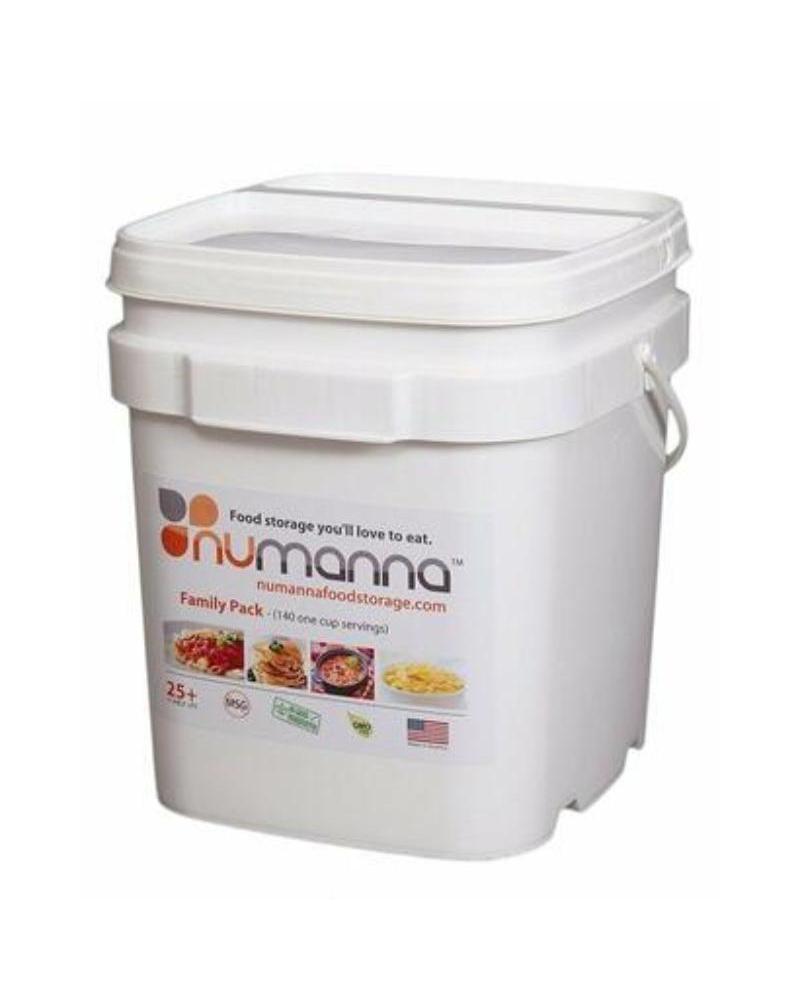
NuManna's current Organic Family Pack contains 162 total servings, but they are not 162 identical entrees. The current breakdown includes 40 servings of organic powdered milk, 20 servings of organic brown sugar oatmeal, 16 servings of organic black chia seeds, 16 servings of organic quinoa, and 70 servings across prepared foods such as chili, soup, pasta, mac and cheese, and pancake mix. That is a useful variety of foods, but the honest way to evaluate the pack is to look at the full composition rather than treating every serving as the same type of meal.
Start where you are and build systematically. You do not need to buy six months of food at once. A tiered approach keeps the investment manageable and gets you covered faster.
72-hour kit (the essential starting point). This covers many common emergency scenarios, including power outages, severe weather, and short-term evacuations. The NuManna Grab-N-Go is a compact way to start, with 80 total servings in a portable bucket designed for emergency storage and mobility. Pair it with an appropriate emergency water supply and additional foods as needed based on the number of people in your household and their actual calorie needs.
Two-week supply (the practical baseline). The American Red Cross recommends keeping a two-week supply of food and water for a stay-at-home emergency kit. FEMA recommends having at least three days of supplies and also suggests considering enough supplies for sheltering at home for up to two weeks. NuManna Family Packs can form the foundation, supplemented with pantry items such as canned beans, nut butters, dried fruit, rice, and other shelf-stable foods your family already eats.
One-month supply (real security). For a family of four, four NuManna Family Packs can form the base of a roughly one-month supply when using NuManna's one-month-per-person sizing, supplemented with a broader pantry. This gives you a more substantial buffer for extended power outages, supply chain disruptions, or severe weather without relying entirely on grocery stores.
Three-month supply (full preparedness). For families who want comprehensive coverage, build toward three months gradually. Using NuManna's one-month-per-person sizing as a planning baseline, a family of four would need roughly 12 Family Packs for three months if relying primarily on those packs. Families who maintain a substantial pantry of rice, beans, canned proteins, nut butters, grains, fats, and other staples may need fewer buckets because those foods contribute meaningful calories and variety.
We have been in the health and wellness space for over seventeen years. We do not add products to our store unless they meet our standards, and we have turned down more brands than we have accepted. NuManna made the cut for specific reasons.
USDA Organic, certified by CCOF. NuManna's Organic Family Pack is USDA Organic, with CCOF serving as the organic certifier. That gives health-conscious families meaningful third-party verification rather than relying solely on terms like "natural" or "wholesome."
Non-GMO ingredients. NuManna states that its Organic Family Pack is made with non-GMO ingredients, which also aligns with the requirements of USDA Organic certification.
Transparent serving breakdown. NuManna publishes the contents of its Organic Family Pack by food type and serving count, making it possible to see exactly how the 162 total servings are composed rather than assuming every serving represents the same type of meal.
25+ year shelf life achieved through process and packaging. NuManna uses long-term packaging such as Mylar pouches with oxygen absorbers and states that its Organic Family Pack contains no artificial preservatives. The long shelf life is built around food preservation and protective packaging rather than depending on artificial chemical preservatives.
A word about honesty. NuManna is not perfect, and we will not pretend it is. Some of their non-organic line includes hydrolyzed vegetable protein, which is a source of free glutamate. We address this directly in our NuManna ingredient review because we believe transparency builds more trust than hype. If you specifically prefer to avoid hydrolyzed proteins, the organic line is the better fit.
One of the most overlooked aspects of emergency preparedness is dietary restrictions. When a storm knocks out power for a week, your celiac disease does not take a vacation. Your child's food allergy does not pause for a natural disaster.
Gluten-free. NuManna offers a separate No-Gluten Family Pack made without wheat, gluten, or soy ingredients. This is different from the Organic Family Pack, which contains several wheat-based foods. NuManna also notes that its No-Gluten Family Pack contains oats and is not manufactured in a gluten-free facility, an important distinction for people with celiac disease or serious sensitivities. We compare the options in our gluten-free emergency food comparison.
Organic and non-GMO. Covered above. NuManna's Organic Family Pack is the option to look at when organic certification and non-GMO ingredients are priorities.
Sodium. Emergency food can be relatively high in sodium, so compare the Nutrition Facts panels of the individual meals rather than assuming that an entire brand is "low sodium." Families who intentionally limit sodium can also supplement their emergency supply with lower-sodium pantry foods.
Multiple sensitivities. If your family manages more than one dietary restriction, our article on emergency food for dietary restrictions and food sensitivities maps out strategies for stacking constraints.
Stop reading and start with one step. Just one.
If you have nothing: start building a 72-hour supply this week. The NuManna Grab-N-Go is an easy entry point, with 80 total servings in a compact bucket. Add an appropriate emergency water supply and enough supplemental food to meet your household's actual needs.
If you have a 72-hour kit: expand toward a two-week stay-at-home supply. Add a Family Pack or other long-term foods along with pantry staples.
If you have two weeks: set a quarterly goal to add another layer to your food supply until you reach your target coverage.
The best emergency food plan is the one you actually build. Start now, build gradually, and make sure every item on your shelf is something you would actually want to eat.
